How We Cut Multi-Company Business Central Data Exports From 18 Hours to 2 Using BC2ADLS
Managing data across multiple Business Central companies can feel like juggling flaming torches. You run eight companies across North America, Europe, and Asia Pacific. Each subsidiary, region, and legal entity operates in its own Business Central instance. Analysts need data from all of them to produce consolidated revenue reports, cross-company customer insights, group-level inventory optimization, and enterprise-wide forecasting. Extracting data from a single company is manageable, but extracting it from eight quickly becomes overwhelming. What once felt impossible changed when we found a better approach.
Understanding the Multi-Company Data Challenge
Most large organizations do not operate with a single Business Central environment. They run five, ten, or even twenty companies. Each company stores critical operational data such as sales transactions, customer records, financial journals, and inventory movements. Finance teams need a consolidated profit and loss view across all entities, operations teams need total inventory visibility, and sales leadership requires insights into global customer trends.
Achieving this requires pulling data from every company into one centralized location, keeping it consistently updated and ready for analysis. Attempting to do this sequentially, company by company, quickly becomes tedious, and the complexity grows faster than teams can manage.
Why We Tried Using APIs First
Initially, REST APIs appeared to be the logical solution. Business Central provides endpoints that can be called in loops across companies and tables. In theory, this approach seems straightforward. In practice, it quickly breaks down. With eight companies and fifty tables each, more than four hundred API combinations were required. Rate limits became an immediate issue. The first company exported smoothly, the second slowed down, and by the third, failures began appearing. Business Central throttled requests, pipelines stalled, retries triggered, and delays compounded.
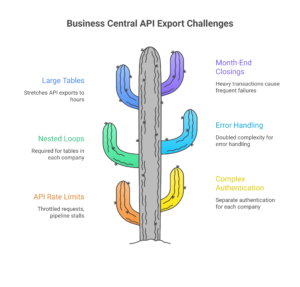
Each company required separate authentication, distinct base URLs, and nested loops for tables. Error handling doubled in complexity. If one company failed, the entire pipeline required complex retry logic. Large tables made the problem worse. A general ledger with 800,000 entries per company grew to nearly six million rows, stretching API exports to more than fifteen hours. Engineers spent entire days tuning backoff strategies. Month-end closings intensified the issue, as all companies processed heavy transactions simultaneously, leading to frequent failures. It became clear that APIs alone could not sustain production workloads.
Why Dataverse Could Not Handle the Scale
Dataverse initially seemed promising because it offered managed synchronization with minimal setup. Enabling Dataverse for three companies worked well. However, when additional companies were added, issues quickly surfaced. Dataverse synchronizes companies independently, making consolidated reporting difficult because data was not aligned in time. One company might finish syncing at 2 AM, another at 6 AM, and another at noon, resulting in inconsistent morning reports.
Custom tables introduced further complications. Different companies used different extensions, causing schema divergence. Managing and maintaining consistency across companies became a full-time effort. Initial synchronization times were also problematic. One company could take four days to complete an initial load, meaning eight companies would require more than a month. By the time synchronization completed, the data was already outdated. Volume limits emerged quickly as well. The largest company contained 12 million journal entries, causing performance degradation and sequential bottlenecks. It was evident that Dataverse could not scale for multi-company analytics.
How BC2ADLS Transformed Our Multi-Company Exports
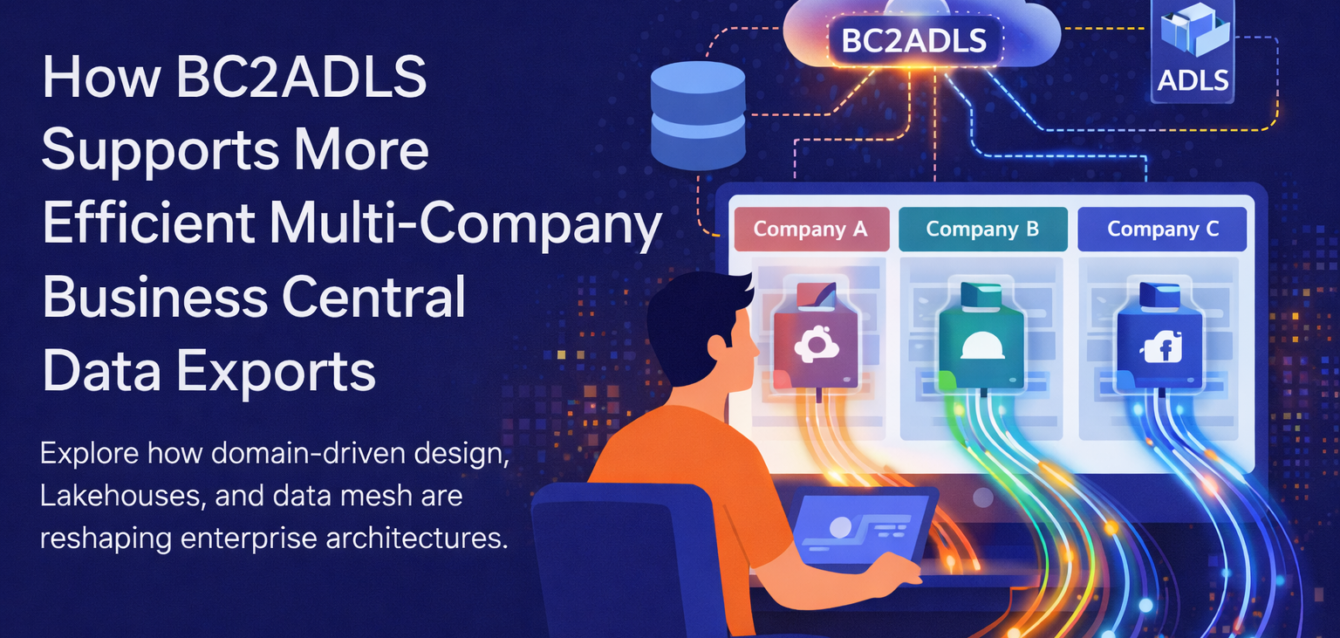
BC2ADLS exports Business Central data directly into Azure Data Lake Storage without middleware or throttling. Data flows straight from source to lake. All companies export in parallel into the same storage account, with each company writing to its own folder.
This parallel execution removes the need for coordination. Installation is straightforward, taking about thirty minutes per company to install the extension, configure Azure Data Lake, and select export tables. Once scheduled, all companies can export simultaneously.
How Multi-Company Exports Work
BC2ADLS writes data in the Common Data Model format, providing a self-describing folder structure with metadata for each company. Fabric connects directly to these folders, allowing analysts to work with data from all companies as if it were a single source. Transformation notebooks combine tables across companies into consolidated datasets. Customer tables span regions, sales tables span entities, and queries can retrieve data from all companies seamlessly.
Parallel Export Saves Hours Every Day
Today, twelve Business Central companies export in parallel using BC2ADLS. Each export runs independently, and no company waits for another to finish. Infrastructure handles concurrent loads automatically. The largest company exports approximately 15 million rows, while the smallest exports about 200,000.
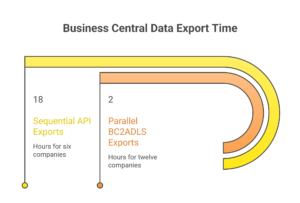
All exports complete within two hours. Previously, sequential API exports took eighteen hours for six companies and would have taken thirty-six hours for twelve. BC2ADLS completes exports in two hours regardless of company count. Engineers no longer need to babysit pipelines, night exports finish before business hours, and morning reports consistently reflect complete data from all companies.
Incremental Exports Keep Costs Down
The initial export transfers the full dataset, but subsequent exports only move changes. BC2ADLS tracks previously exported records and transfers only new or updated data.
With twelve companies and sixty tables each, daily incremental exports move roughly three percent of total data volume. Even during month-end processing, incremental exports handle millions of records smoothly. Storage costs remain predictable, network transfer costs stay low, and Fabric processing time drops by 80 percent because only changed data is transformed.
Access to Every Table and Extension Matters
Business Central includes hundreds of tables, covering standard entities, system tables, audit logs, and custom extensions. APIs expose only a fraction of this data, and Dataverse focuses primarily on common entities.
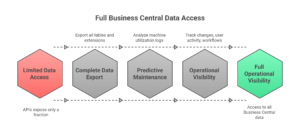
BC2ADLS exports everything. This complete access enabled manufacturing teams to analyze machine utilization logs and quality inspection records, leading to predictive maintenance models that reduced downtime by 18 percent. Change logs, user activity tracking, and workflow states also became available, delivering full operational visibility across all companies.
Near Real-Time Updates With Fabric Mirroring
BC2ADLS operates on scheduled exports, while Fabric mirroring provides continuous replication with updates syncing within minutes. Sales teams rely on mirrored tables for dashboards that refresh frequently, while finance teams use nightly exports for historical accuracy.
Operations teams leverage both approaches, using mirroring for real-time inventory insights and BC2ADLS for long-term demand analysis. Mirroring works independently per company, allowing consolidated views to update continuously.
Simplifying Multi-Company Management
Before BC2ADLS, multi-company exports were fragmented, with different schedules, error handling, and monitoring processes per company. Now, everything follows a consistent pattern with the same extension, configuration, and monitoring approach. Azure Monitor provides a unified dashboard across all companies, alerting engineers only when issues arise. Adding a new company takes about four hours from installation to production data flow. Integrating recent acquisitions took less than a day each, with reports updating within two days.
Real Performance Improvements
Before BC2ADLS with six companies:
- API exports took 18 hours
- Failed twice weekly on average
- Engineers spent 12 hours per week fixing pipelines
- Data current as of previous night
- Custom table data unavailable
After BC2ADLS with twelve companies:
- All exports finish in two hours
- Zero failures in eight months
- Engineers spend one hour per month monitoring
- Data current within hours or minutes
- Every table accessible, including custom extensions
Storage costs: $350 per month for15 terabytes across twelve companies. compute costs dropped by 65 percent. Engineers focus on analytics, not pipeline maintenance
Why BC2ADLS Wins for Multi-Company Exports
BC2ADLS eliminates rate limits by exporting all companies simultaneously and letting infrastructure handle the load. Each company exports independently, removing coordination complexity. The Common Data Model carries schema metadata, eliminating mapping headaches. All tables export without restriction, including custom extensions. With no middleware and no vendor lock-in, data remains in your Azure storage under your control, significantly reducing total cost of ownership.
Consolidated Data Enables Better Business Decisions
With BC2ADLS, consolidated financial reporting became straightforward. Cross-company customer insights informed account strategies. Global inventory optimization freed $3 million in working capital. Enterprise planning accuracy improved, and executive dashboards began showing real-time performance across regions.
Getting Started With Multi-Company BC2ADLS
The first week focuses on a proof of concept for a single company and validating data quality in Fabric. The second week adds more companies and builds consolidated tables. The third week expands to all companies and configures schedules and monitoring. By the fourth week, production cutover occurs, legacy API pipelines are retired, teams are trained, and documentation is updated. Within a month, full production is achieved across multiple companies, hundreds of tables, and millions of rows with reliable daily updates.
Final Thoughts
Business Central separates companies operationally, while BC2ADLS brings them together for analytics. All companies, all tables, and all data reside in one storage location, one Fabric workspace, and one reporting layer. Instead of struggling with multi-company exports, BC2ADLS handles the complexity so teams can focus on insights and better decision-making. The tool exists, the pattern works, and consolidation unlocks what is possible